Category Archives: thought - Page 20

cooling down

Moving to Texas was a rough adjustment for me. Completely worth it, all things considered, but not easily done. When I’m having a miserable day due to the insanely hot and muggy weather I’ll often ask whoever it is calling me a whiner “How many vikings do you find in the jungle?” That said, the three digit temperatures seem to have retreated and we’re supposedly headed into the tolerable part of the year when the wind blows cool and breathing outside doesn’t hurt. I know that not all of Texas is like this, but the coastal plains are pretty miserable starting in May and running through, well, close to now. With the humidity and heat index dropping, my work ethic is growing. I’m coming out of hibernation.

POWER UP, BABY!

And it’s just in time! September 23rd, as some part or other of the mighty Internet has told me, marks the point where there are 100 days left in 2009. Since my little 10 Days Project to kill my personal creative block, I have become a huge fan of random deadlines made up of round numbers. With that in mind, I am planning to complete the following projects:

  • Release my current collection of songs in an album-like format. FOR FREE!
  • Complete the piece of electronic/computer/tape music that has been buzzing around in my brain and notebooks.
  • Optional: finish building my acoustic guitar (I’m so very close now). [This is optional due to weird things like humidity and potential tool acquisition.]

The part of me that thinks this is too modest a list hasn’t really listened to the so called drum mixes on the tracks I’m preparing. He needs to get in line with the “24 hours in a day” principle.

pencils

Computers have solved a lot of problems for me. My happy little MacBook Pro takes care of almost every facet of my life. All of my creative work is recorded there. My family pictures and my music collection both reside in its domain. Most of the communication I have with my friends and family is computer based. It’s a marvel and an incredible tool. But there must always be balance. For every Logic Studio there is a twitter account. For each video chat between my son and his grandmother there is a Facebook. In truth, the computer in my life is a time altering device. It greatly amplifies or diminishes the quality of my time. I see little middle ground.

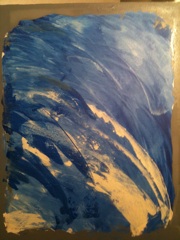
Case in point: I have eight songs that aren’t so bad. I’m moving them around and mixing and remixing bits and pieces. Trying to polish them without losing any of the strange edges. It’s not easily done and it’s impossible to do with 100% focus. I should say it’s impossible for me to do with 100% focus. My mind wanders. I lose track of what I was listening for. The flow comes and goes. But if my hands are busy, I can focus infinitely. Since practicing scales or noodling with the guitar while listening does’t work well and I never learned to crochet, I have taken to painting while I listen.

Again, I’m not a painter. It’s one of the things I do without holding myself to any kind of standard. I’m allowed to suck. Everyone should have a hobby like that!

With the music moving and a notebook at hand, I drag the paint around the canvas on a tour of its edges. Colors combine and create divisions. I am calm and centered. It’s a meditation. When the songs end, I remember my comments exactly and I note them. The playlist starts over and I return to the paint.

After a second listening and some notes I’m reluctant to turn to the computer. The constant input is too much. I make more notes in my journal and enjoy the sound of the pencil on the paper. It occurs to me that in terms of creative problems, the pencil has done me more good than the computer. What I feel is a sense of the quality of my time. The computer can take tasks like recording or editing and make them so efficient that I can do more in an hour than I could do in a day ten years ago. I can fit a room’s worth of effect pedals and rack units in its tiny case. In those instances, it is improving the quality of my time. I can do more in less and that’s amazing.

It’s the other chunks of time that concern me now. Breezing through endless status updates or clicking random links. It’s like a slot machine but more addictive and less riddled with guilt. The addiction to the twitches on the web comes easily. Effortless stimulus on demand. Time simply disappears. And that’s the problem. If my time is going to disappear, I would prefer that it go in the pursuit of making things in a far less efficient manner. Pushing pencils. Filling notebooks and idly strumming on the floor of my studio.

I’m unplugging more (he said in his blog). At night, the computer goes into the studio and stays there. Less time on the network and more time using the tools. And much more analog activity. More notebooks. More staff paper. More pencils. And an evil side project that appeared to me in a nap and literally fell from the top shelf of my closet.

showing up

It’s been weeks since I raved about The War of Art by Steven Pressfield so I need to ramp it up again. I read a lot and there have been many books that have impacted the way I work but never has one gotten me into the habit of working like this one. The motivational force it contains and unleashes on the unwitting artist is impressive.

I get excited about my studio time throughout my day. On my drive to work I listen to what I did the night before. At lunch, I edit and review and journal about it. On the way home, I visualize my session and think deeply about what I want to accomplish. But with the boy in bed and the day’s chores all done it is still difficult to drag myself into the studio and drop down into the headspace needed for the energizing but draining process. It is so much easier to plop down on the couch with a book or the endless timesuck that is the Internet and accomplish nothing. But the passage from The War of Art that affected me most deeply leaps to mind and literally saves my day:

A professional always shows up.

I think about how tired I was that morning when I got out of bed. Maybe I was a little on the ill side. The urge to call in might have been there, but I didn’t. I got dressed, drove my car to my job, and went to work. I was a professional. And I owe my creative work the same level of respect afforded to my colleagues at my day job. I have to show up for me.

pickin' and grinnin'

I’m certain that the amount of effort and mental fortitude required to avoid the many and varied distractions available to the modern person have a lot to do with why so many projects don’t get finished or even started. It isn’t easy to close the web browser and open a new empty document or work on that painting that has been languishing on the easel for a month and taunting its creator. How many songs are hummed while mowing the lawn and never get written because someone posted another “How well do you know that guy you went to high school with but haven’t spoken to in over a decade” quizzes on Facebook?

The difference between a novelist and a guy with a story idea is hundreds of hours of work and a finished product that can be pointed to and shared. Well, that and the immense satisfaction that comes from completing something that wasn’t demanded by anyone but himself. Is there anything better than that?

I’m not an extrinsically motivated person. The carrot and the stick are wasted on me. If the desire to do something doesn’t start inside of me, there’s little hope for it. That’s true in any part of my life and I think it’s true for most people. But if we don’t show up, all of that desire is for naught.

And showing up? It feels good. When I leave my studio at the end of even the worst session I still feel better than if I had gone to bed without putting in the time. None of it is wasted when it’s spent developing my craft. The same can’t be said of the myriad toys and silliness that pass for relaxation.

feasting

The week has passed with Hemingway’s A Moveable Feast on the nightstand. I find myself going back to books about the early 20th century and the Americans who flocked to Europe when fall comes. Those writers and their romantic expatriate lives in the smokey, booze filled cafes in Paris are enough to make anyone pine for a time in which he did not and could not live. On this reading, one of dozens, the book speaks to me differently. I find myself wondering “how does the math work out?”

What a horrible thing to think while reading about Hemingway’s days spent working in and wandering around Paris at a cultural flashpoint. But it’s where my mind goes. How did he pay for all of it? There is mention of journalism and all of its sordidness. There was the selling of some stories. But how did it work? I’m sure I don’t know and just as certain that there is probably a piece out there that would tell me with little effort on my part but instead I close my eyes before bed and wonder how I would do what he did. At the time, he had a wife and son and so do I. Too much logistics and not enough inspiration.

This wasn’t why I picked up the book. The desire was to draw parallels between his way of working and mine. To try and find an appreciation for a man whose method and ethos I prize but whose work I have never been able to love. It’s something I come back to every now and again in the hopes that I might be able to make it work. I can feel the failure already, but reading it is its own reward. It’s wonderful to crawl inside someone else’s mind and watch their life unfold. Memoirs of artists are fascinating because of that explanation. It’s a window into the why and the how of the what.

shiny

Paying for my overpriced cup of burnt coffee with the recharged gift card that I use to maintain my lunchtime coffee and sanity budget, I think about the “coffice” culture that has come along with the advent of portable computing. I remember studying in coffee shops and even sleeping in them occasionally in school, but with the arrival of the laptop and the ubiquitous corporate coffee, complete with wifi, the illusion of the cafe culture is almost a caricature of what I imagine those writers lived. But it’s a pale imitation to my mind. Patrons interact rarely. The tables for two usually seat one person and a bag. Faces lit by web browsers, email, and millions of social networking toys rarely glance at one another. I think of Hemingway laughing aloud at a memory and being looked at by the waiter. I wonder how often he engaged in conversation with other patrons. Or did he simply stick his face in his notebook or newspaper? I would like to think that we’re not all that far apart, but a nagging feeling tells me that I’m a far cry from some of those ideals though I may be closer to some.

There’s a wanderlust that comes when I read Hemingway. I wish from time to time that I could break out and roam the way he did and force the math to work. Grab my wife and son and rush off to Europe to be in the center of it all. Not that there is a center anymore. At least not like there was then. And it’s that kind of a center that I would like to experience at some point in my life. But I’m content as long as the work is getting done. My studio may only be a spare bedroom, but all things considered, I’ll take it over Paris.

An eighth song was added to my collection last night. I’m sorry to say that I’m getting quite attached to these songs and the way they flow together. I hope that someone enjoys them as much as I do, even if it’s not in the same way. The week of October 12th is the most likely release date.

sounds lost and found

1959 was a year for jazz that’s easy to remember. The albums that came out are among the best produced in the history of recorded music. Kind Of Blue by Miles Davis. Time Out by Dave Brubeck. Coltrane’s Giant Steps and Mingus Ah Um (by Charles Mingus). And the one that made the least sense to me when I first heard it, The Shape of Jazz to Come by Ornette Coleman.

The first time I came across The Shape of Jazz to Come was in college when it was loaned to me by a buddy of mine. This guy was a little too hip for his own good, but being the pretentious young composer I was, I took it from him and tried to choke it down. This is not the kind of music that one listens to while doing something else. Music like this requires a monastic stillness of mind and complete focus of the type I didn’t know existed then. As a result, I returned it graciously and went about my business.

It was years later when I was living in New York City that it made sense. Working four jobs and going to school full time doesn’t make for much of a social life. Most of my days and nights blurred together and were lived within the confines of my head. My days ran around the clock and sleeping wasn’t something that I did as often as I should have, so some of my walks between various jobs and school (I didn’t have enough money for public transportation) were made while only half awake. One of the benefits of this was the mental idle time that allowed me to think through things without being interrrupted. It was the kind of sleep walking that you can only do on that island.
i don't get it

In that half-sleep I could hear the sound of the crowd. Traffic. Pedestrians. Horns. Sirens. Truck brakes discharging. Metal trashcans. Music blaring from apartment windows. Doors slamming. The omnipresent footsteps. The sounds buzzed and slowly blurred into one another. There was no rhythm or harmony, but the sound moved forward. There was a destination that was always just over the horizon and never closer.

On a rainy day, the sound of my boots on the pavement added a pulse to this unstoppable wave of sound. To my mind then it felt like adding a backbeat to Stockhausen. That made me think of Coleman. New York City is its own free jazz. I have lived in other cities since but have never managed to recapture that sound. On my way into work this morning, it dawned on me that this was the thinking behind the collection of pieces I’m working on right now.

Each of the tracks is very ambient and contains what sounds like background noise. Part of that stems from a happy accident I had while reviewing some recordings at the cafe a couple of weeks ago. I had an enabled track in Logic and while I thought I was listening, I was actually recording. What came from that was a highly effected recording of the cafe noise around me blurred behind two dueling guitars. Magic like that needs to be captured.

And now I’m adding the pulse. The final product will likely be tracks that will fail miserably in a car or on a home stereo. The only way to hear them, really hear them, will be through headphones (aka the audiophile’s bane). Today I’m embracing that limitation and taking it to its logical conclusion, whatever that may be.

I guess part of me is still back on that street with the percussive puddles under my feet and the sound of a million lives going on around my head.